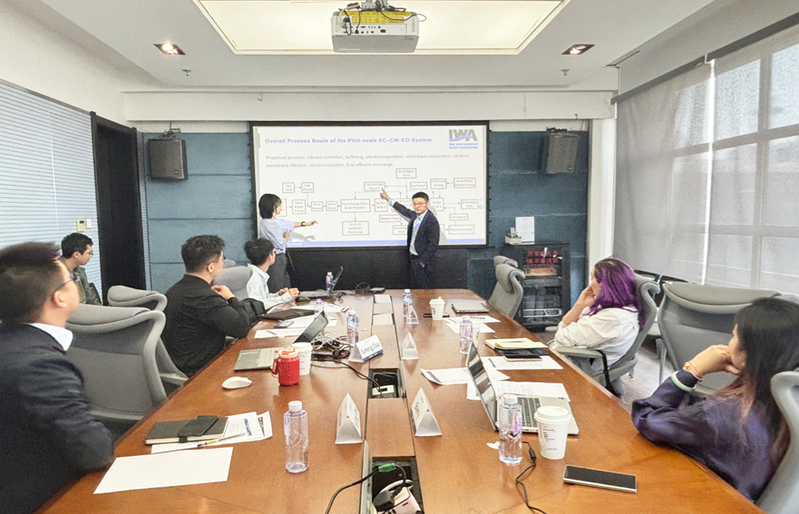
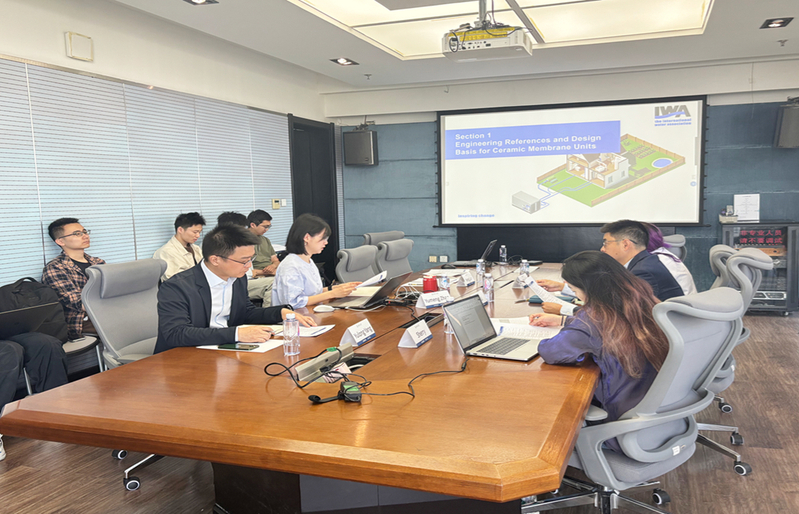
From May 13 to 14, Dr. Tao Li, Executive Vice President of the International Water Association (IWA), visited the School of Environment at Harbin Institute of Technology for the mid-term review and academic exchange of the global “Next Generation Sanitation Systems” project. Dr. Elena Fernandez-Miranda and Dr. Sherry Wu from IWA also participated in the visit.
Focusing on the “Next Generation Sanitation Systems” project, Dr. Tao Li and his delegation held in-depth discussions with the research team led by Professor Jun Ma, Member of the Chinese Academy of Engineering and Professor at Harbin Institute of Technology. Participants included Professor Yumeng Zhao, the project leader from Harbin Institute of Technology; Dr. Tao Li, Dr. Elena Fernandez-Miranda and Dr. Sherry Wu from IWA; Professor Meng Sun from the Research Center for Eco-Environmental Sciences, Chinese Academy of Sciences; and Associate Professor Yulong Yang from Jingdezhen Ceramic University.
The participants discussed the technical needs of sanitation and water systems for remote regions and decentralized application scenarios worldwide. The discussions focused on key topics including the development of decentralized water treatment processes, the coupling mechanisms between electrochemical processes and ceramic membrane filtration, energy consumption optimization, integrated equipment design, and future demonstration pathways. The meeting further clarified the project’s mid-term progress, technical optimization directions, and priorities for future collaboration, laying a solid foundation for equipment development and international demonstration oriented toward practical application scenarios.
During the visit, Dr. Tao Li delivered a lecture entitled “Paradigm Shifts in the Water Sector: New Challenges and Emerging Scenarios” to faculty members and students of the School of Environment. The lecture addressed major challenges facing the global water sector, including climate change, innovation translation, and water pricing mechanisms. Dr. Li systematically analyzed the importance of greenhouse gas management, water technology innovation systems, and sustainable financing models. He noted that emerging technologies and application scenarios, such as non-sewered sanitation, desalination, and digital twins, are reshaping the future development pathways of water systems. With its global perspective, strategic insights, and forward-looking vision, the lecture provided valuable inspiration for faculty and students to better understand global trends in the water sector and broaden their research perspectives.
Dr. Tao Li and his delegation also held a meeting with Professor Heng Liang, Dean of the School of Environment, and Professor Yu Tian, Director of the State Key Laboratory of Urban Water Resource and Environment. The two sides exchanged views on the international development of the School of Environment, collaboration with IWA platform resources, young talent cultivation, and international academic cooperation. Both sides expressed their willingness to take this visit as an opportunity to further deepen collaboration between the School of Environment at Harbin Institute of Technology and IWA in scientific research, talent development, international communication, and global water governance practices, jointly contributing to the development of sustainable water systems worldwide.
This visit further strengthened mutual understanding and collaboration between the School of Environment and IWA, promoted the high-quality implementation of the “Next Generation Sanitation Systems” project, and injected new momentum into the School’s efforts to expand its international cooperation network, enhance its global academic influence, and contribute to sustainable development in the global water and environmental sectors.