Prof. Liang Heng and Tang Xiaobin’s team from the School of Environment at Harbin Institute of Technology (HIT) has engineered a biomimetic nanofiltration (NF) membrane with anti-Janus charge structure for lithium recovery from waste lithium battery wastewater. The study, titled Advanced biomimetic nanofiltration membranes for lithium recovery with anti-Janus charge structure , has been published in Nature Communications.
NF membranes with high Li+ selectivity are crucial for cost-effective Li+ recovery, benefiting to addressing the global lithium shortage. However, conventional positively charged NF membranes typically exhibit Janus charge distribution structure,namely, positive charge layer-by-negative charge layer, which would cause the excessive accumulation of counterions between the Janus charge layers, and led to the so-called electrostatic shielding effect to susceptibly cause the local positive charge field cancellation, resulting in the reduction of both multivalent cations removal and Li+ selectivity.
Inspired by the internal electrical structure of dust storms, where the positive-negative mosaic-like charge structure generates strong electric fields to facilitate the particle transport, Prof. Liang Heng and Tang Xiaobin’s team proposed a discrete micro-nano isolated island strategy to transform the layer-by-layer charge structure of Janus charge (JC) NF membrane into the positive-negative mosaic-like charge structure within the NF membrane to provide pathways for the rapid motion and transport of Li+. This strategy innovatively designed a quaternary ammonium electrolyte, 4-amino-N,N,N-trimethylpiperidinium bromide (ATPB), characterized by a monosubstituted amine and short-chain conformation. These specifically structural features enabled ATPB to modify the polyamide (PA) membrane in a point-to-point manner, thereby restructuring the electronegative PA layer into a mosaic-like anti-Janus charged (AJ) NF membrane with discrete domains of positively and negatively charged islands.
The resultant AJ NF membranes demonstrated an exceptional Li+/X2+ selectivity, exceeding that of conventional PIP-TMC membranes by 647%-904%, with desired Li+ penetration at 84.99%. This was related to that the mosaic-like charge structure within the AJ NF membrane generated a microelectric field, which facilitated both the low energy barrier and rapid transmission of Li+. Moreover, the point-to-point anchoring of ATPB prevented additional crosslinking or lamellar growth, which benefited to achieving a high permeability at 20.72 L m-2 h-1 bar-1. Furthermore, this study developed an evaluation metric, Critical Efficiency Product (CEP),for assessing Li⁺ recovery performance more comprehensively and accurately. Overall, this study is expected to promote the rapid development and application of NF technology in the field of lithium resource recovery.
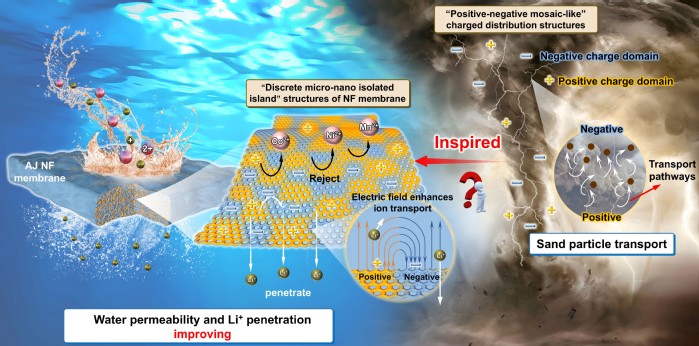
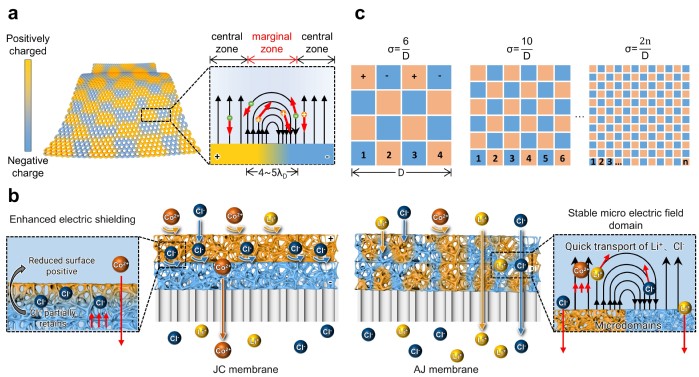
Mechanism of Li+ separation by biomimetic AJ NF membrane
School of Environment, State Key Laboratory of Urban Water Resource and Environment, from Harbin Institute of Technology, is the first corresponding institution of this paper. Prof. Heng Liang and Tang Xiaobin from HIT are the co-corresponding authors. PhD candidate Wang Yanrui from School of Environment at HIT is the first author. Master candidate Zhang Yaru, PhD candidate Zhang Meng and Jiang Shu from School of Environment at HIT mainly participated in the relevant research work. This work was jointly supported by the National Key Research and Development Program of China, the National Natural Science Foundation of China, and National Key Laboratory of Urban and Rural Water Resources and Water Environment Research Project.
Link to paper: https://www.nature.com/articles/s41467-025-66887-2