The research team led by Professors Wang aijie and Li Zhiling from the School of Environment at Harbin Institute of Technology (HIT) and members of the State Key Laboratory of Urban Water Resource and Environment, in collaboration with Professor Duan Xiaoguang from the University of Adelaide to develop enzyme structure-inspired Fenton-like functional catalysts for simultaneous water pollution control and carbon resource recycling.
The research finding, title Axially engineered single atoms in enzyme-mimic-binding pocket steering dehalogenation–polymerization pathways toward water pollutant upcycling, has been published in Nature Communications.
Conventional advanced oxidation processes for treating halogenated organic pollutants face challenges such as low reaction efficiency, poor product selectivity, and limited long-term stability, which hinder carbon resource recovery and may lead to secondary pollution.
To address these challenges, the team developed an axially nitrogen-coordinated single-atom iron catalyst inspired by the structure of CYP152 peroxidase. By strongly electron-withdrawing chlorophenol, it triggers an electron transfer pathway that achieves complete dechlorination and efficiently converts the compound into oligomeric products.
The exceptional charge confinement properties of the carbon nitride support enable the conversion of oxidants into active surface hydroxyl intermediates. This facilitates nucleophilic substitution of organochlorine species while simultaneously driving C-O cross-linking polymerization of hydroxylated byproducts, demonstrating exceptionally high electron utilization efficiency.
The integrated dechlorination-hydroxylation-polymerization process can be scaled up to plant-scale water treatment with excellent stability. The collected oligomers can be processed into industrial-grade plastic products, reducing material costs by ~31% and carbon footprint by ~78%.
HIT is the first corresponding institution for the paper. Wu Bin, a doctoral candidate from the School of Environment, is the first author. Professor Li Zhiling, Professor Wang Aijie and Professor Duan Xiaoguang are the corresponding authors. Professor He Shixin from the School of Environment, along with master's candidates Zhang Jie and Zhou Weiyu, participated in the related research work.
This research was supported by the National Natural Science Foundation of China (NSFC) General Program, the National Innovation Research Group Program, and the National Key Research and Development Program.
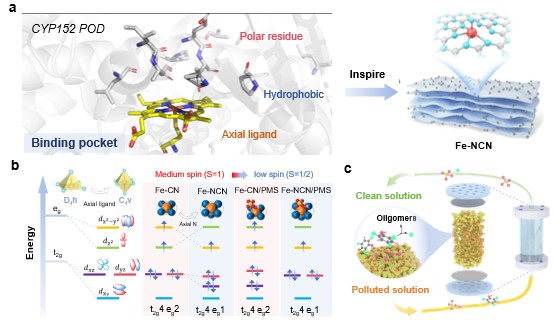
Figure. (a) Axial Design Approach for Enzyme-Mimetic Catalysts, (b) Dehalogenation-Polymerization Mechanism, and (c) Integrated Design for Water Pollution Control and Resource Recovery.