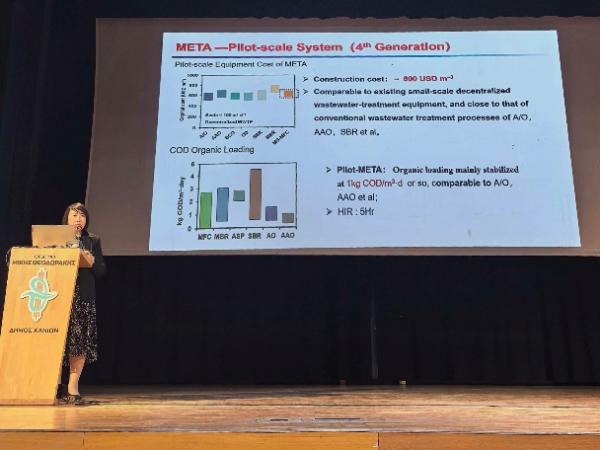
From September 13 to 17, 2026, the 19th IWA International Conference on Wetland Systems for Water Pollution Control (ICWS 2026) was held in Chania, Greece. The conference brought together 350 participants from 55 countries, with 300 accepted abstracts, 225 oral presentations, 75 poster presentations, 38 scientific sessions, and 7 keynote speakers, making it one of the largest and most international conferences in the field of wetland systems and water pollution control. Professor Yujie Feng and Associate Professor Guohong Liu from the School of Environment, Harbin Institute of Technology, were invited to attend the conference and deliver academic presentations on sponge city construction, low-carbon wastewater treatment, ecological restoration based on nature-based solutions (NbS), and in-situ remediation of aquaculture systems, sharing their latest research advances and engineering practices.
During the conference, Professor Yujie Feng delivered a keynote presentation entitled “Low-carbon wastewater treatment and NbS for ecological restoration: experiences from China.” The presentation focused on low-carbon wastewater treatment and nature-based ecological restoration technologies, and comprehensively introduced China’s achievements in sponge city construction based on NbS over the past two decades, highlighting the international significance of these practices and their contributions to the development of sustainable urban water systems worldwide. Professor Feng further presented the team’s research progress and engineering applications in sponge city construction, black and odorous water remediation, ecological embankment systems, and electron-enhanced ecological restoration technologies. Professor Feng emphasized that, in response to carbon peaking and carbon neutrality goals, urban water environment improvement needs, and ecosystem restoration challenges, water system restoration should shift toward integrated approaches featuring low-carbon development, resource recovery, and nature-based solutions. By strengthening the application of artificial intelligence and advanced ecological materials, and through the construction of multi-scale ecological units and in-situ pollutant reduction strategies, coordinated improvements in water quality and ecological functions can be achieved.
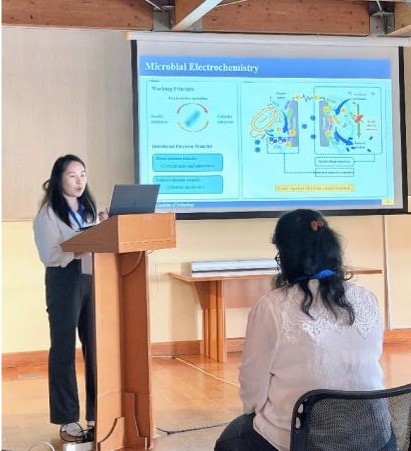
Associate Professor Guohong Liu delivered an oral presentation entitled “In-situ remediation of aquaculture system based on the electron sharing network between water and sediment.” The presentation focused on the challenges of pollution control in aquaculture systems and discussed the construction of electron-sharing networks at the water-sediment interface and their role in pollutant transformation. The presentation highlighted the team’s recent research progress in aquaculture wastewater treatment, sediment pollution control, and enhanced ecological restoration technologies.
The conference focused on international topics including constructed wetlands, nature-based solutions, low-carbon water treatment, agricultural non-point source pollution control, urban stormwater management, and ecological restoration, attracting experts, researchers, and practitioners from around the world. During the conference, Professor Feng’s team engaged in extensive academic discussions with international researchers on wetland-based pollution control, nature-based solutions, low-carbon water treatment technologies, and sustainable aquaculture water management, further strengthening international academic exchange and cooperation in the field of water environment management and ecological restoration.