From October 5 to 9, a delegation of faculty members and students from the School of Environment at Harbin Institute of Technology (HIT) visited the Federal Research Centre The Yakut Scientific Centre of the Siberian Branch of the Russian Academy of Sciences and M.K. Ammosov North-Eastern Federal University (NEFU) in Yakutsk, Russia. The visit aimed to strengthen scientific cooperation and exchanges among young researchers between China and Russia, with a focus on Arctic climate change, environmental and ecological protection in cold regions, and green, low-carbon technologies. Through international forums, thematic seminars and site visits, the delegation presented the School's research progress and explored further opportunities for cooperation in polar environmental research.
Visiting the Yakut Scientific Centre of the Siberian Branch of the Russian Academy of Sciences to Strengthen Arctic Research Cooperation
On October 5, faculty members Zifeng Zhang and Wanli Ma from HIT's School of Environment visited the Yakut Scientific Centre of the Siberian Branch of the Russian Academy of Sciences and held cordial discussions with its General Director, Academician Mikhail P. Lebedev of the Russian Academy of Sciences. Aimed at strengthening China-Russia cooperation in Arctic research, the meeting focused on environmental change in high-latitude cold regions and the needs of joint scientific expeditions. The two sides explored opportunities for research collaboration, field observations and academic exchanges.
Zifeng Zhang presented HIT's research progress in the Arctic, highlighting its work on polar environments and ecosystems, environmental monitoring in cold regions, and international cooperation, as well as its research experience and achievements in these areas. Professor Mikhail P. Lebedev outlined the Yakut Scientific Centre's research priorities and recent achievements. Drawing on local environmental conditions and research facilities, he shared experience in conducting scientific surveys and long-term observations in the Arctic. The two sides held in-depth discussions on global climate change, Arctic environmental and ecological protection, and the sharing of research resources, and explored potential directions and mechanisms for future joint research.
The discussions placed particular emphasis on plans for Arctic field expeditions. The two sides reached a preliminary agreement to jointly establish an ecological research station in the Tiksi area of Russia's Sakha Republic and to conduct joint scientific expeditions and environmental sampling. They also held preliminary discussions on subsequent expedition arrangements, sampling plans and researcher exchanges, laying the groundwork for implementing the joint expeditions.
Academician Lebedev spoke highly of the meeting, noting the strong foundation and considerable potential for cooperation in polar science. He expressed the hope of strengthening academic ties with HIT and expanding cooperation on research projects and exchanges among young researchers. Professor Wei Wang, Vice Dean of the School of Environment, and Professor Yi-Fan Li, Chief Scientist of the Polar Research Institute, joined the meeting online.
Participating in the Northern Sustainable Development Forum to Deepen China-Russia Scientific Cooperation
On the afternoon of October 7, the delegation attended the roundtable From Yakutsk to Antalya: Shaping a Consolidated Arctic Voice for COP31 at the Seventh Northern Sustainable Development Forum. Representatives from research institutions, regional organizations and businesses discussed permafrost degradation, ecological change, infrastructure resilience and climate adaptation, exploring the important role of scientific research in Arctic sustainable development and international climate governance.
The delegation then participated in an open discussion on China-Russia cooperation in the Arctic. Representatives from local governments, international organizations, universities and research institutions exchanged views on regional cooperation mechanisms, sustainable Arctic tourism, cooperation in research and education, and transport corridors. Zifeng Zhang delivered a presentation entitled The Polar Research Institute of Harbin Institute of Technology and Research on the Arctic Environment and Ecosystems, introducing HIT's research priorities and progress in international cooperation in polar environmental research, and presenting relevant research findings.
Participating faculty members and students said that the exchanges deepened their understanding of Arctic environmental change and China-Russia regional cooperation, broadened their perspectives on environmental science in cold regions, and reinforced their appreciation of the importance of international scientific cooperation and the development of young researchers for sustainable development in the Arctic.
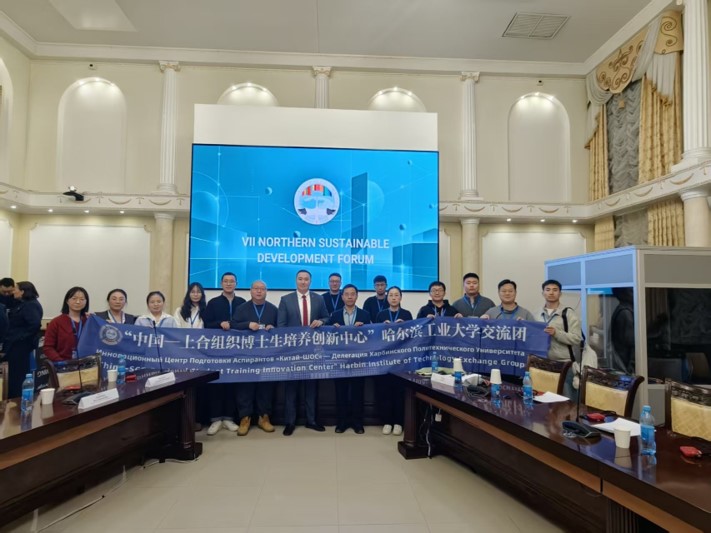
The HIT delegation with fellow participants at the forum
Discussing Emerging Contaminants and Low-Carbon Technologies to Promote Academic Exchanges among Young Chinese and Russian Researchers
On the morning of October 8, an open discussion session entitled Emerging Contaminants and Low-Carbon Technologies: Monitoring, Modelling and Solutions for Northern Regions was held at North-Eastern Federal University, chaired by Kolodeznikov Vasilii Egorovich, Director of its Institute of Natural Sciences. Researchers from HIT, North-Eastern Federal University, and the Institute for Biological Problems of Cryolithozone of the Siberian Branch of the Russian Academy of Sciences delivered 17 presentations. Of these, 12 were given by HIT's associate research fellows Xue Zhou and Huihang Sun and ten doctoral students, who presented research findings on environmental monitoring, risk assessment of emerging contaminants, pollution control and low-carbon technologies. Russian researchers shared their progress in studies of tundra ecosystems, plant physiological ecology, greenhouse gas observations and the conservation of rare migratory birds.
Researchers from North-Eastern Federal University's Institute of Natural Sciences praised the event, noting that the HIT presentations covered a wide range of topics and perspectives and demonstrated the young researchers' solid academic foundations and innovative spirit. They expressed interest in further research cooperation in environmental monitoring, pollutant transport and transformation, and green, low-carbon technologies.
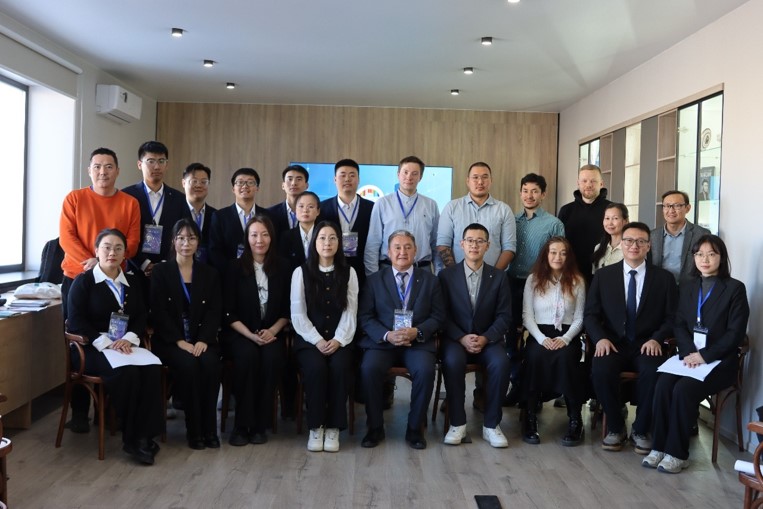
Participants in the discussion session on emerging contaminants and low-carbon technologies
Exploring Permafrost Landscapes and Natural History Collections to Broaden Perspectives on Cold-Region Research
Alongside the academic exchanges, the delegation made site visits to learn about the local natural environment. On the morning of October 7, faculty members and students visited the Kingdom of Permafrost in Yakutsk, where they observed frost crystals and ice formations inside the cavern and learned about local permafrost conditions through the exhibits. The visit provided a more direct understanding of the natural conditions of cold regions and changes in permafrost. On October 9, the delegation visited the P. A. Lazarev Mammoth Museum in Yakutsk and the specimen museum of North-Eastern Federal University's Institute of Natural Sciences.
Participants said that the site visits brought scientific questions in cold-region environmental research to life, deepening their understanding of the distinctive and complex local ecosystems and environment. The visits also inspired ideas for research from the perspectives of long-term environmental change and interdisciplinary collaboration.
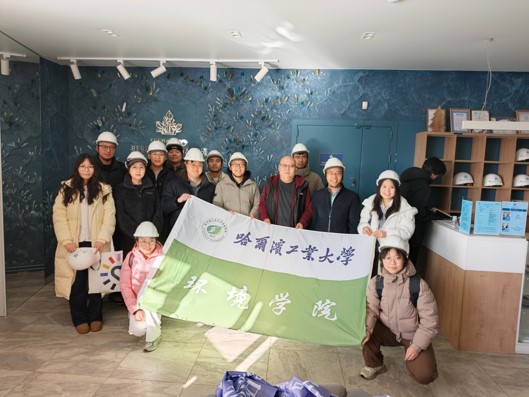
School of Environment faculty and students at the Kingdom of Permafrost in Yakutsk.
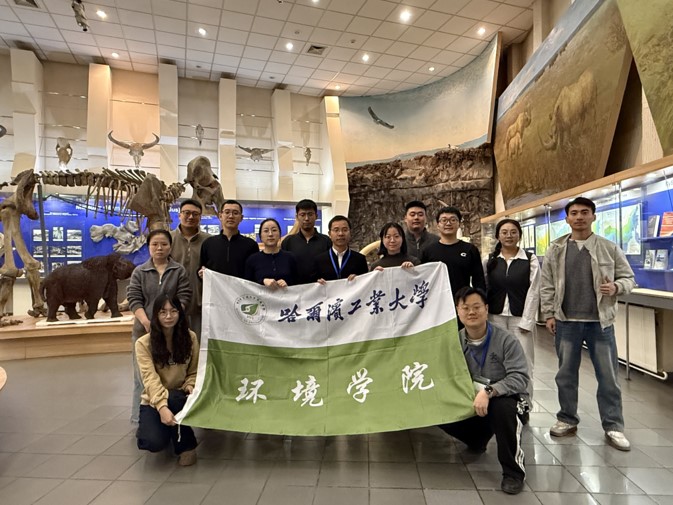
The delegation at the P. A. Lazarev Mammoth Museum in Yakutsk
The visit was an important step in the School of Environment's efforts to deepen international academic exchanges and expand cooperation in polar environmental research. By participating in international forums, thematic seminars and site visits, faculty members and students gained a better understanding of advances in environmental science in northern regions, presented the School's research progress in environmental monitoring, pollution control and low-carbon technologies, and strengthened mutual understanding with researchers at Russian universities and research institutions. The School will continue to strengthen academic exchanges with relevant partners and explore opportunities for cooperation in cold-region environmental research, exchanges among young scholars and talent development, building further experience in polar environmental science and the training of researchers with international perspectives.